
Skip to content
← All services Service 03

IoT Infrastructure

Buildings, fleets and facilities produce data every second and throw almost all of it away. We connect the sensors, collect the signal and turn it into something a manager can act on this morning.
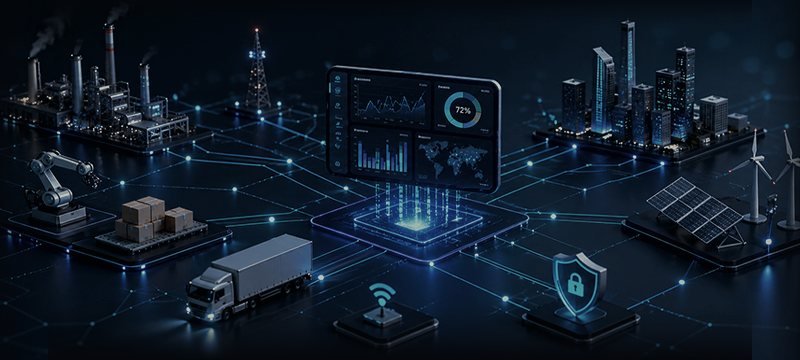
Connected factories, vehicles, wind turbines and buildings reporting into one live dashboard.
The problem we solve

What this is

A tower, a warehouse, a clinic or a fleet is a physical system with a measurable pulse: temperature, occupancy, energy draw, water flow, door events, vibration, air quality, vehicle position. Most of it is already measurable with inexpensive hardware.

We design the sensing layer, get the data somewhere safe, and put intelligence on top: thresholds that raise an alert before a failure, patterns that show where energy is wasted, and a single screen instead of six vendor portals.

Typical result: lower operating costs and live visibility of every asset.

Fit

Who this is for

A good fit if

  • Owners and facility managers paying energy bills nobody can explain line by line.
  • Buildings with equipment that is serviced on a calendar instead of on condition.
  • Operators juggling six vendor dashboards that do not talk to each other.
  • Developers and property managers who want live occupancy, comfort and consumption data.
  • Fleet, warehouse and cold-chain operations where a failure has a same-day cost.

Probably not yet if

  • The building is about to be handed over or refurbished and the systems will change anyway.
  • No one will act on an alert once it is raised, so measuring changes nothing.
  • A single utility meter reading once a month already answers your question.

If one of these is true we will say so in the first call, and tell you what to fix first.

Engagement

How we can work together

01

Survey and sensing plan

A site visit and a written plan: what to measure, with which hardware, at what cost, and which decision each measurement serves.

02

Pilot floor or asset

One floor, one chiller or one vehicle instrumented end to end, so the saving is proven before the rollout is funded.

03

Rollout and operate

Full deployment with a monitoring agreement: device health, data quality, alert tuning and quarterly reporting.

Every engagement starts with a free consultation and a written proposal. Scope, price and the measure of success are agreed before any work begins.

Deliverables

What you get

A sensing plan

What to measure, where, with which hardware, and what each measurement will actually be used to decide.

Devices and connectivity

Sensor selection, gateways, LoRaWAN, Wi-Fi or cellular, installation planning and commissioning.

A data platform

Secure ingestion, time-series storage, retention rules and an API your other systems can read.

Live dashboards

Floor-by-floor or asset-by-asset views, built for the person on site, not only for the head office.

Alerts people trust

Tuned thresholds and anomaly detection, routed to the right person on the right channel, without alarm fatigue.

Predictive maintenance

Models that learn the normal behaviour of a chiller, pump or lift and flag the drift before the breakdown.

Process

How it works

  1. 01

    Site survey

    We walk the building or the yard, check what is already instrumented, test connectivity and list what can be reused.

  2. 02

    Pilot on one zone

    One floor, one line or one vehicle group, instrumented end to end, so you see real numbers before a full rollout.

  3. 03

    Rollout

    Phased installation with minimal disruption, each phase commissioned and verified before the next.

  4. 04

    Intelligence layer

    Baselines, anomaly models, optimisation rules and the reports your facilities or ESG team actually needs.

  5. 05

    Operate

    Monitoring of the monitors: device health, battery and signal, so a silent sensor does not become a silent risk.

Use cases

Where it fits

  • Towers and communities: chilled water, lifts, common-area energy and leak detection in one view.
  • Retail and F&B: cold-chain temperature logs that satisfy an inspector without a clipboard.
  • Warehousing: occupancy, forklift movement, door and dock activity, and energy per pallet handled.
  • Facilities management: predictive maintenance that turns callouts into scheduled visits.
  • Fleets: location, driving behaviour, fuel or charge use, and automated trip reporting.

What we build it with

  • LoRaWAN, Zigbee, Modbus, BACnet and MQTT
  • Edge gateways with local processing for low latency
  • Time-series databases and streaming pipelines
  • Integration with BMS and existing building controls
  • Anomaly detection and forecasting models
  • Dashboards on web and mobile, Arabic and English

What we need from you

  • Access to the site and to your facilities team
  • Drawings or asset lists, even if out of date
  • Permission from the building owner or operator where needed
  • One operational problem worth solving first
Accountability

What we measure

We agree the numbers before the work starts and report against them afterwards. These are the measures that usually matter for this service.

  • Energy use per square metre, before and after
  • Unplanned breakdowns and the hours lost to them
  • Alerts raised before a failure versus after it
  • Device uptime and the share of readings that arrive clean
  • Water consumption and leak detection time
  • Comfort complaints per month in the monitored zones
Experience

Mistakes we help you avoid

  1. Measuring everythingEvery sensor costs money forever. Measure what someone will act on, and leave the rest for later.
  2. Alert stormsThresholds that fire fifty times a day train your team to ignore the one alert that mattered.
  3. Locked-in hardwareIf the data only leaves through one vendor's portal, you are buying their roadmap, not your own.
  4. No owner for the dataA dashboard nobody is responsible for opening on Monday morning stops being read within a month.
FAQ

Questions, answered.

Do we have to replace our existing systems?

Usually not. Most building management and control systems can be read through standard protocols, so we add a layer rather than rip anything out.

What happens if the internet drops?

Gateways buffer locally and sync when the link returns, and critical rules can run at the edge so an alert does not depend on the cloud.

How small can we start?

One floor or one asset group is a sensible pilot. It is usually enough to show whether the savings justify a wider rollout.

Who owns the data?

You do. We can host it in your cloud account or in a region your policy requires, and export is always available.

Initiate

Let's wire intelligence
into your business.

Acta, non Verba.

THE BRAIN● ONLINE · NEURAL CONCIERGE